
Supported living services
Learn about Garland lodge supported living services and the care and support we provide.
What is supported living?
Supported living is a way for individuals to live independently in their own homes while receiving tailored support to meet their needs. Unlike residential care, people in supported living have their own tenancy agreement, giving them control over their environment, routines, and day-to-day decisions.
At Garland Lodge, supported living is about more than care it’s about building lives that are meaningful, empowering, and full of choice. Our approach combines professional guidance, personalised support plans, and Positive Behaviour Support (PBS) to ensure individuals can:
Develop life skills such as cooking, budgeting, and travel
Participate in their community through volunteering, social activities, and events
Make their own decisions about how they live, work, and spend their time
Receive consistent, compassionate support that respects their individuality
With supported living at Garland Lodge, every individual is seen, heard, and celebrated. We create homes where people can thrive, grow, and achieve their personal goals all while retaining independence, dignity, and control over their lives.
Who is supported living suitable for?
- Supported living is designed for adults who want to lead fulfilling lives in their own homes while receiving guidance tailored to their individual needs. At Garland Lodge, we welcome people with a variety of conditions, including those on the autism spectrum, individuals with learning disabilities or mental health challenges, and those living with brain injuries, physical disabilities, or complex needs. Our skilled teams work closely with each person to develop personalised plans that focus on their strengths, ambitions, and preferences. With Garland Lodge, supported living provides the freedom to make choices, take part in everyday life, and pursue personal goals within a safe and nurturing environment.
A range of accommodation options
All of our tenants’ homes are comfortable, modern, and designed to promote independence. Many properties are equipped with assistive technology to help residents manage daily tasks and live confidently in their own space.
Supported living at Garland Lodge offers a variety of accommodation options to suit different preferences and needs. We provide flexible solutions tailored to each individual, ensuring that every person has a home that reflects their goals and lifestyle.
By understanding what each individual wants and needs, we help determine the most suitable housing and location. We can provide guidance on tenancy agreements, giving residents the security and confidence of their own home. For those who wish to live with others, we carefully match individuals with compatible housemates who share similar interests and lifestyles.
Our approach to supported living
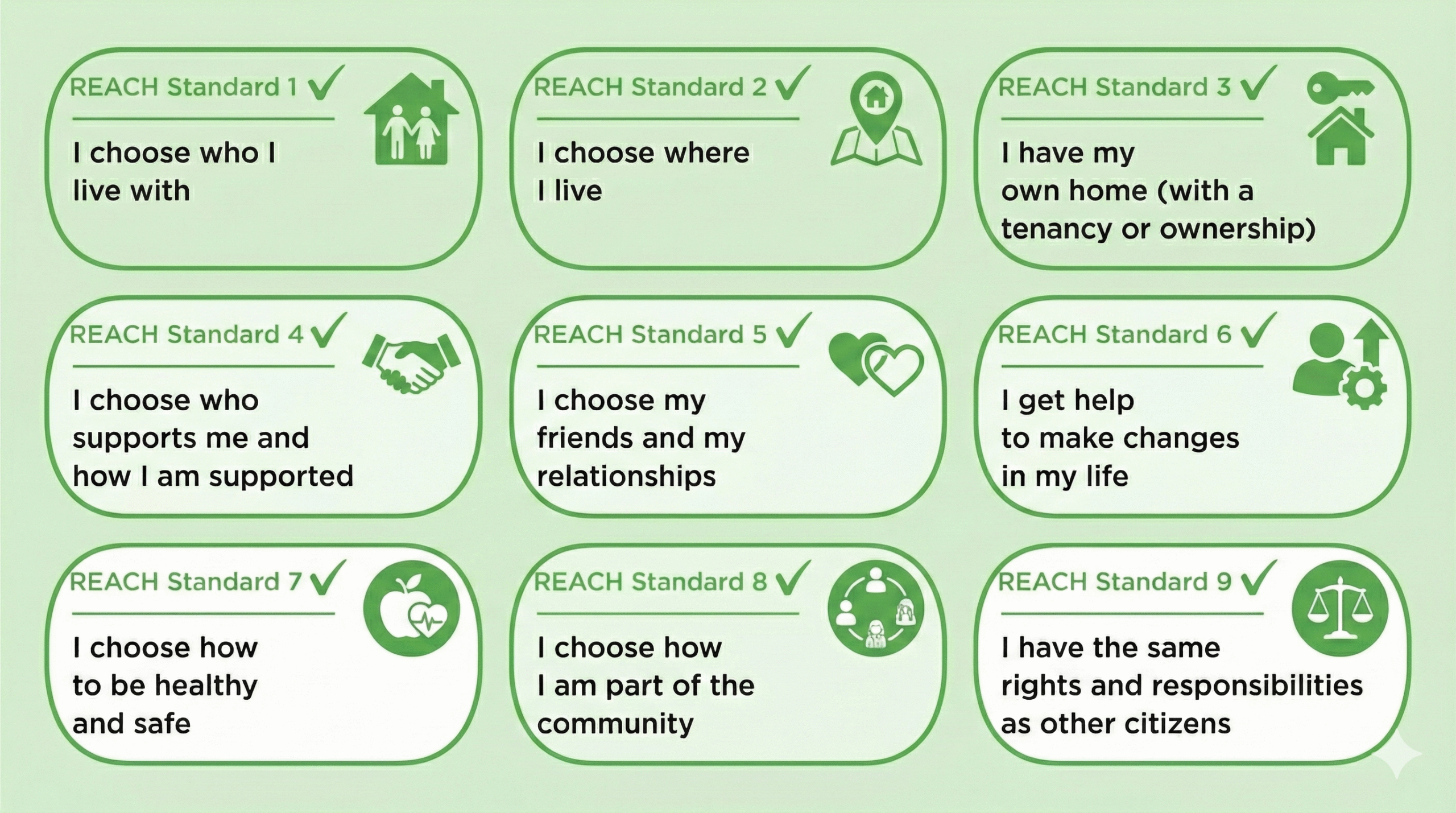
- At Garland Lodge, we focus on each individual’s unique needs, preferences, and goals. Our person-centred approach, guided by the Reach Standards, ensures that every person has the opportunity to make their own choices about how they live their life.
- We also provide tailored care pathways for individuals transitioning from independent hospitals or residential care settings. We understand that moving into supported living can be a significant change, so every transition is carefully planned and personalised to ensure a smooth, positive experience.
- Our approach is about more than providing care it’s about empowering individuals to thrive in their homes, develop new skills, and achieve meaningful goals with confidence and dignity.
Staff availability 24 hours a day
Our support packages range from a few hours a week to one-to-one support.
A wide range of safe and homely living options
We have established partnerships with housing providers, providing a range of different accommodation options.
Integrated assistive technology
Some of our properties are equipped with integrated assistive technology to promote independence.
Experienced staff teams
Our staff teams receive bespoke training to meet the needs of each person.
Unique care pathways
Garland national network of services can facilitate smooth step-up and step-down transitions.
Locations across the UK
Ideally located within communities, our homes have good access to local amenities.
Person-centred care and support programmes
Our tenants are supported to develop their daily living skills and enhance their independence.
Support to build independence
To promote independence, our teams support people to access education and employment opportunities.
Helping our tenants live their lives to the fullest
Garland Lodge is passionate about providing our supported living service tenants with as much independence as possible, enabling them to live a life of their choice, supported by Garland Lodge every step of the way.
To demonstrate this, our practices reflect the guidance of The Reach Standards across our supported living services. The Reach Standards are a set of nine voluntary standards created by Paradigm, to ensure people are supported to live the life they choose – with the same choices, rights and responsibilities as other citizens. These standards ensure our focus remains on continually delivering a high level of quality support, and that there's ongoing dialogue with our tenants in consideration of this.
The Reach Standards are recommended by health and social care regulators, and are the most widely recognised standards across the UK in relation to supported living. These standards are even fed into our central records system, Nourish, to ensure discussions with tenants take place and are recorded to enable us to monitor and review progress.
Frequently asked questions
Supported living is an arrangement whereby a person receives a package of care and support to enable them to live in their own home. These services help people to live happy and fulfilling lives and achieve the things they want to achieve.
Someone in supported living will have their own home and tenancy agreement. They will be responsible for the cost of living and paying their bills, with support from staff. This means that supported living can offer greater autonomy and personal space. Someone in residential care will not have these responsibilities.
You may be eligible for supported living if you are above the age of 18, and need support to live independently. Garland supports adults with a range of conditions, presentations and needs, such as:
- Autism
- A learning disability
- Mental health needs
- An acquired brain injury (ABI)
- Prader-Willi syndrome (PWS)
- Complex needs
- Physical disabilities
- A forensic background
- Behaviours that may challenge
Supported living is a service that enables people to maintain their independence in their own homes. Everyone in supported living has their own tenancy, and they manage their own bills and daily expenses. This makes supported living a good way to blend assistance with self-reliance.
Support is available from a few hours a week to 24 hours a day, 7 days a week, including on a one-to-one basis. We provide care and support across a range of areas. These include:
- Community inclusion
- Domestic tasks such as cooking, cleaning and shopping
- Personal care
- Taking medication
- Managing finances and budgeting
- Accessing education opportunities and voluntary or paid employment
- Helping with claiming and managing benefits
- Accessing leisure and social activities
- Maintaining links with family and friends, and establishing new relationships
- Supporting healthy lifestyles
Garland has established partnerships with housing providers across the UK, offering a variety of supported living accommodation options. The types of housing we offer include:
- Self-contained flats
- Communal houses
- Communal bungalows
- Bespoke solutions
- Outreach support
By understanding each person’s needs and goals, we can agree the type of accommodation and locations that might work best for them.
All of our tenants’ homes are comfortable and modern. Many have assistive technology services to support daily living. Their convenient locations provide easy access to amenities and transport links. Some types of supported living accommodation are entirely self-contained, while others share communal facilities with other tenants.
The landlord or housing provider will make repairs to the home. In the event of deliberate damage, it's the responsibility of the tenant to fund any repairs. Details of this will be included within their tenancy agreement.
Friends and family are welcome to visit at any time.
The properties generally come unfurnished, and we can support people to pick out their furniture. We also encourage tenants to personalise their spaces to their tastes, in accordance with their tenancy agreement.
The Care Quality Commission (CQC), the Care Inspectorate Wales (CIW) and the Care Inspectorate (CI) in Scotland regulate our supported living services. Our own internal quality teams also oversee our schemes. This ensures a robust and responsive approach, which means that we can support people in the best possible way.
As tenants, the people living in a supported living service pay for their own accommodation. They may fund this via housing benefits in the form of rent payments to the housing provider.
You will pay for the support services provided by the care provider separately. Funding options include direct payments, or funding from your local authority or the NHS. The fees may vary, and we base them on an assessment of each person's needs.
Please visit our funding and referrals page to learn more about how you can fund our services.
With our support and where possible, tenants pay for their day-to-day living expenses, such as food and clothing. Tenants are responsible for paying bills and any additional outgoings they may have, such as contents insurance, internet access and a TV license.
Those eligible for funding should contact their local authority. Please visit our funding and referrals page to learn more about how you can access support.
Contact us for help, referrals or more information
If you have any questions or need further information about funding, referrals or our supported living services, please don’t hesitate to get in touch with us.